Given the fact that I’ve now spent almost 4 months in Dar es Salaam, it would be reasonable to ask, as several of you have, “But I thought you said you were working in Lindi and Mtwara?” Yes, those 100+ interviews with rural women still loom large on my radar screen, but before I can start my research, there are a lot of hoops to jump through, and that means navigating two very complicated bureaucracies (those of Tanzania and Johns Hopkins). I’m glad there are no windows to jump through, because I might have seized that opportunity on a couple of choice occasions in the last few months. There are two main classes of hoops: 1) getting a residence permit to clear me to do research in two specific regions of the country, and 2) getting ethical approvals from a number of different committees in the US and Tanzania. Even after waiting 4 months, I haven’t yet received my residence permit OR full ethical approval, and so can’t get started on the interviews.
Emerging unscathed from one’s struggles with the system seems very much a function of luck, and I’ve had more than my share of bahati mbaya (bad luck). A wayward letter of support got lost on someone’s desk in a government office 10 weeks ago, delaying my research permit by 2 months and, because a research permit is a prerequisite for a residence permit, delaying that too. Cross your fingers that I will get it before my visa expires next weekend! On top of that, the coordinator of the ethical committee here at my organization was brand new, and her learning the ropes delayed my proposal by a month. To add insult to injury, the ethical committee at Johns Hopkins just transitioned to a new online system this fall and the automatic classification system initially misclassified my proposal, delaying the review on the US side by more than a month. Bahati mbaya!
Facing known delays and wanting to do more with my time than just learning Swahili, I’ve gotten involved in a lot of the other newborn health programs, policies, and research that are ramping up here in my organization and at the national level, which includes key stakeholders including the Ministry of Health, WHO, UNICEF, and Save the Children. This has been my first exposure to the national policy and planning environment and a great learning experience. Working with a couple of other staff here, we got a 3-month mini-grant from Save the Children to analyze existing interviews that contain information about pregnancy and birth from several different regions in the country. The project has been a great introduction to the culture and reproductive histories of women in Tanzania, particularly in the area where I will be working. The mini-grant supports an assistant and a consultant to help go through and analyze the interview transcripts, which has meant that I needed to be in the office every day to train and supervise them.
Needing to be at the office meant that spending 3-5 hours commuting every day no longer made sense. Josh and Bre were very generous to house this wayfaring stranger for three months, but it made sense to move closer to the office. So for the month of February, I have moved in with one of my Tanzanian co-workers, her sister, and her nephew in a small 2-bedroom cottage in a shared compound 10 minutes’ walk from my office. No more daladalas or 40 minute slogs through mud on rainy days! They have been incredibly hospitable to me, giving me my own room (I suspect that I am sleeping in one of their beds but they are too polite to tell me whose) and sharing meals. I have also learned a lot firsthand about how relationships work in Muslim families and the richness of Swahili culture that I had only read about before. Living with them is something of a cultural exchange: I made tacos for my adoptive family last night and my co-worker’s sister, Zoela, remarked that she has never even tried mzungu food before.
I’m heading home to the US in a few weeks for a two-week visit before jumping into the fieldwork component of my research here, so my days left in Dar are numbered. It’s a much-needed visit to see Matt, my family, my dog, and my friends; to take a few warm showers; to take in a lot of cheese, chocolate, and wine; and to gear up for the next 6 months. Before I head home, I’m trying to line up a couple of research assistants for my fieldwork, as well as the specific logistics for how I get to and how long I will stay in each village, how I will charge laptops with no electricity, how to approach interviewees, how to manage my project budget, and what kinds of training I need to do before launching headlong into data collection. Overwhelming, especially as I am anything but a natural manager of other people (and Matt can tell you that planning ahead is not my cup of tea). But I’m spurred on by the hope of finishing everything by my anniversary in August…
So that’s my long-winded update – I’d love to hear what all of my friends are up to!
Tuesday, February 13, 2007

Friday, January 26, 2007
Maintenance
It is a fairly effective rule of thumb when visiting a city in Africa and looking for a place to stay not to ask for the best hotel but for the newest one. If open for less than a year, even the most basic hotel can be a pleasant place to stay. But the quality seems to tend to deteriorate rapidly thereafter; once broken, items in the rooms are rarely fixed, and if so, creative jerry-rigged arrangements are the norm rather than the exception.
We had a new daladala station open here 6 weeks ago paved with laid bricks and with raised islands to channel the buses. I was paying more attention to it than usual on my way home the other day and noticed that most of the concrete curbs along the raised islands are already chipped, crumbling, or missing, the casualties of foot traffic and the weight of too-wide buses attempting to force their way through. Only faint vestiges of the yellow stripes on the curbs remain, having been completely rubbed away by a combination of bus tires, shoe soles, and the gritty dirt that seems to cover everything here, despite the best efforts of the tireless women who toil in the hot sun as street sweepers. The whole station looks as though it could have been built decades ago and neglected ever since. 6 weeks--somehow I find that a bit disturbing!
Paul Theroux in Dark Star Safari (a rather sensationalist and stereotyped account of an journey across Africa by a rather unlikable man, but somehow memorable) laments that the school library he helped to build and set up in Malawi as a Peace Corps volunteer in the 1960s has been looted for its books and left to decay. Theroux was far from the first to observe that things tend to fall into disrepair in much of Africa over time, but the Western world has tended to be content to stereotype this tendency toward entropy as a consequence of some culturally imbedded laziness or carelessness. Few people ever bother to look beneath these easy—-but oversimplified and very often wrong—-explanations. Surely there are lazy and careless people here, but Tanzania is no more special in that regard than the rest of the world!
Many, many people work extraordinarily hard to maintain their property in Tanzania. I have seen spotlessly tidy homes here, where floors are swept daily, clothes are washed by hand (each article meticulously ironed), and every item dusted daily. Even the sandy ground in my housing compound is swept to clean up the debris each morning. I would argue that laziness is certainly not the culprit in most cases (indeed, any impression of laziness one gets is generally explained by high rates of unemployment and a general shortage of jobs). Some actions I have observed may seem careless on the surface—such as daladala drivers driving over curbs, or people discarding their trash in the streets—until one considers that the daladala driver’s livelihood depends on extricating himself from the traffic jam as quickly as possible to pick up more fares, even if that means driving over curbs, and the fact that Dar es Salaam has no trash pick-up service, few public trash cans, and most trash is tossed into heaps and burned.
A significant fraction of the challenge of maintenance in Africa must be attributable to the poor quality of many of the materials from which buildings are built and the hot, wet, muddy climate. I often wonder how different Tanzania, Africa, and much of the developing world might look if only good quality cement, asphalt, and high quality paint were the norm (or even available). It is not uncommon that a road can be paved and have crumbled to bits within a season. Certainly, building to last is not impossible: the tarmac airstrip at the airport is miraculously smooth, and there are some roads that seem to last for several years. But this takes incredible investments of engineering, inputs into importing or producing quality materials, and the advanced equipment to do a good job. In just a year or two, a new building’s exterior paint is likely to be faded, chalky, dirty, and covered in mildew. Large cracks in the concrete of even the fanciest and newest buildings here are not uncommon.
Paying for and seeing a construction project through here presents other feats of coordination. It can take months or years to obtain permits, build, and finish a structure here. Since credit is difficult to obtain and interest rates are extremely high, most people build homes as they can afford them, meaning that many homes languish as cinder-block shells for years, crumbling in the sun, before enough money materializes to afford a roof, a cement surface on the walls, doors, or screens/bars on the windows. It is no wonder that it is hard to tell the difference here between a home completed 2 years ago and a home completed 20 years ago – indeed, ground might have been broken for both in the same year!
Yet another aspect is economics. Put simply, maintenance costs money and time, and it is hard in a country where the average income is a few hundred dollars per year for many people to afford the time and money to invest in maintaining their homes and businesses. Buying powerful and effective cleaning products is expensive; it is no wonder that many cleaning solutions are used sparingly or diluted with water (as is paint, for that matter). Ultimately, for the lower and middle class here, the effort needed to survive–-whether survival takes the form of pounding cassava or working long hours in a low-paying, unskilled job–-can easily trump the priority of a fresh coat of paint on the walls or mending a cracked windowsill.
Surely even these musings hardly provide a comprehensive explanation for why maintenance is often a losing battle here in Tanzania, but it seems only fair to recognize people's extraordinary efforts to work with what they have.
We had a new daladala station open here 6 weeks ago paved with laid bricks and with raised islands to channel the buses. I was paying more attention to it than usual on my way home the other day and noticed that most of the concrete curbs along the raised islands are already chipped, crumbling, or missing, the casualties of foot traffic and the weight of too-wide buses attempting to force their way through. Only faint vestiges of the yellow stripes on the curbs remain, having been completely rubbed away by a combination of bus tires, shoe soles, and the gritty dirt that seems to cover everything here, despite the best efforts of the tireless women who toil in the hot sun as street sweepers. The whole station looks as though it could have been built decades ago and neglected ever since. 6 weeks--somehow I find that a bit disturbing!
Paul Theroux in Dark Star Safari (a rather sensationalist and stereotyped account of an journey across Africa by a rather unlikable man, but somehow memorable) laments that the school library he helped to build and set up in Malawi as a Peace Corps volunteer in the 1960s has been looted for its books and left to decay. Theroux was far from the first to observe that things tend to fall into disrepair in much of Africa over time, but the Western world has tended to be content to stereotype this tendency toward entropy as a consequence of some culturally imbedded laziness or carelessness. Few people ever bother to look beneath these easy—-but oversimplified and very often wrong—-explanations. Surely there are lazy and careless people here, but Tanzania is no more special in that regard than the rest of the world!
Many, many people work extraordinarily hard to maintain their property in Tanzania. I have seen spotlessly tidy homes here, where floors are swept daily, clothes are washed by hand (each article meticulously ironed), and every item dusted daily. Even the sandy ground in my housing compound is swept to clean up the debris each morning. I would argue that laziness is certainly not the culprit in most cases (indeed, any impression of laziness one gets is generally explained by high rates of unemployment and a general shortage of jobs). Some actions I have observed may seem careless on the surface—such as daladala drivers driving over curbs, or people discarding their trash in the streets—until one considers that the daladala driver’s livelihood depends on extricating himself from the traffic jam as quickly as possible to pick up more fares, even if that means driving over curbs, and the fact that Dar es Salaam has no trash pick-up service, few public trash cans, and most trash is tossed into heaps and burned.
A significant fraction of the challenge of maintenance in Africa must be attributable to the poor quality of many of the materials from which buildings are built and the hot, wet, muddy climate. I often wonder how different Tanzania, Africa, and much of the developing world might look if only good quality cement, asphalt, and high quality paint were the norm (or even available). It is not uncommon that a road can be paved and have crumbled to bits within a season. Certainly, building to last is not impossible: the tarmac airstrip at the airport is miraculously smooth, and there are some roads that seem to last for several years. But this takes incredible investments of engineering, inputs into importing or producing quality materials, and the advanced equipment to do a good job. In just a year or two, a new building’s exterior paint is likely to be faded, chalky, dirty, and covered in mildew. Large cracks in the concrete of even the fanciest and newest buildings here are not uncommon.
Paying for and seeing a construction project through here presents other feats of coordination. It can take months or years to obtain permits, build, and finish a structure here. Since credit is difficult to obtain and interest rates are extremely high, most people build homes as they can afford them, meaning that many homes languish as cinder-block shells for years, crumbling in the sun, before enough money materializes to afford a roof, a cement surface on the walls, doors, or screens/bars on the windows. It is no wonder that it is hard to tell the difference here between a home completed 2 years ago and a home completed 20 years ago – indeed, ground might have been broken for both in the same year!
Yet another aspect is economics. Put simply, maintenance costs money and time, and it is hard in a country where the average income is a few hundred dollars per year for many people to afford the time and money to invest in maintaining their homes and businesses. Buying powerful and effective cleaning products is expensive; it is no wonder that many cleaning solutions are used sparingly or diluted with water (as is paint, for that matter). Ultimately, for the lower and middle class here, the effort needed to survive–-whether survival takes the form of pounding cassava or working long hours in a low-paying, unskilled job–-can easily trump the priority of a fresh coat of paint on the walls or mending a cracked windowsill.
Surely even these musings hardly provide a comprehensive explanation for why maintenance is often a losing battle here in Tanzania, but it seems only fair to recognize people's extraordinary efforts to work with what they have.
Monday, January 22, 2007
Errors of omission

One very important part of my life has been largely missing from these posts. I left a life I love dearly at home to occupy a strange new world here alone, one that oscillates between exotic and absolutely exhausting. And one very important person in that life -- my husband -- can't be here with me. I have joked to my friends here that “When I said ‘I do,’ I didn’t mean I do want to live a year without my husband!” In an absolute sense, Matt’s and my being apart now is voluntary, in that of our own free will one of us could get on a plane anytime and rejoin the other. But the painful calculus that went into making this decision rendered it the most logical option. Staying the course on significant investments of time, money, and effort will hopefully help us gain enough freedom and flexibility to live simpler lives long-term. But that is not to say that every day apart isn’t tremendously painful after putting so much effort these last seven-plus years to build a life together. We are certainly fortunate to have the benefits of multiple forms of fast and affordable daily communication – email, Skype, phone, text messaging – but all of these fall far short of being together, and I would never recommend this arrangement to anyone else.
Thankfully, after a number of trial-related tribulations at work, Matt was able to visit me for the holidays, including miraculously making a 6-minute connection in Zurich after a delayed flight from New York just to get here on time. We stayed in Dar for a few days so he could see my life (meet my friends, visit my office, see where I lived), and thankfully the weather cooperated so he was able to see Dar at its muddiest as well as Dar at its hottest, both of which are endearing characteristics! On Christmas Eve, we escaped to Zanzibar for 8 days, spending Christmas in Stone Town and New Year’s Eve on the beach on the East Coast at Matemwe Beach Village, the same place we stayed when we visited Zanzibar 4 years ago while living in Ethiopia. The beaches, scenery, and architecture on Zanzibar are breathtaking and almost stereotypically an exotic paradise. It’s hard to leave once you get there [the pictures below give a glimpse].


The fusion of Arab, Indian, and mainland African influences, particularly in Stone Town, is fascinating and beautiful.


We had wonderful multi-course dinners each night in Stone Town, one served sitting on pillows at low tables in an atmospheric Zanzibari-style rooftop deck [picture below is me there with the Indian Ocean in the background], and a formal Christmas dinner in a hotel on the beach with the windows open to the seabreeze, candles in hurricanes, and a Swahili gospel choir performing outside. Being a seafood lover I was in heaven. It felt like a true escape from the pressures of both our lives.

In the planning stages, we had had high hopes to go snorkeling or diving, take a tour of Zanzibar’s famous spice plantations (especially cloves, vanilla, and cinnamon bark), see dolphins, or take a forest tour to see monkeys. As it happened we didn’t do any of those things at all, as we were more than content just being together unfettered by schedules or obligations. Our rooms in both places were peaceful, spacious retreats and we rarely ventured out except to eat or walk on the beach, content to spend the days together making up for time apart. Below is a picture of Matt looking more relaxed than he has been in years!


On one occasion when we did venture out, Matt got a very memorable, if injurious, massage in a beach banda (hut) by the hotel masseuse. Having had a startlingly similar experience at a hotel in Ethiopia, he promises to write a guest blog entitled “The Lesser-Known Perils of Massage in Developing Countries.” At Matemwe, we were fortunate to have the run of a huge Swiss Family Robinson-style bungalow suite with a lounge area with swing-beds, and a very imaginative layout including open-air toilet and shower and a complete absence of straight lines, including, as it happened, the posts that held the thatched roof on the whole structure, which torqued rather noticeably after some strong winds one night while we were there [picture below]!

We had a curious monkey come visit one evening, swinging through the posts of our thatched roof and clearly perturbed we were there. Matt promptly ceded control of our suite to the monkey, retreating to the (ceilinged) bedroom. Monkey 1, Matt 0.
I couldn’t have asked for a better Christmas present than to have Matt visit me, and while he is no longer physically here with me in Tanzania, he needn’t be absent from this blog…

Whatever the opposite of a White Christmas is…
Better late than never, right? I have a backlog of blogs I've written but not had time to upload... and I am shamefully late on the Christmas greetings!
Some of you have asked about Christmas here in Tanzania. Context clues when Christmas is approaching are few but oddly garish in tropical snow-less countries like Tanzania. Thanks to healthy trade with India and South Africa (and increasingly, China), we suffered no shortage here this holiday season of gaudy foil banners, tinsel, lights, cheap plastic ornaments, and unattractive plastic foil giftwrap to herald the glorious occasion of Christ’s birth. The intense heat, palm trees, and mud conflict with most stereotypical images of the Christmas season, seemingly provoking the irresistible urge to set out brash, non-biodegradable reminders of the holiday season.
Examples? A stubby—and slightly off-putting— 4’ mzungu Santa Claus figurine greets me with an electronic wave and a goofy painted-on grin outside the grocery store next to my favorite café. An ice-cream bike (yes, the Good Humor Man doppelganger in Tanzania works sans van, vending slowly melting treats from a bike-mounted cooler) rides by, emitting a shrill synthesizer version of the first two lines of “Jingle Bells” (the verse, not the chorus) on a persistently annoying loop. Strings of multicolored lights are everywhere, wrapped on trunks of palm trees along shop roofs, anywhere where there is electricity and spare disposable income. Even though I have no love for artificial plastic trees, the spirit was infectious, and I admit I was tempted to buy a small one here, if other Tanzanians hadn’t beaten me to it and bought the stores out. The Christmas spirit is alive and well here in Tanzania. We just have mud instead of snow.
Bre and Josh hadn’t executed any grand plan to decorate the house for Christmas, so they were surprised one evening to hear a loud thud outside followed by a car speeding off down the road in the dark. When they went out to investigate, they found a large loose evergreen tree had been lobbed over the gate, a last resort for delivery by our friend Paul after numerous efforts to rouse our guard from his slumber had failed. So the house was filled with the fresh scent of some unknown genus of evergreen, the look completed with a couple of 99-cent stockings from Target (as above, think garish/gaudy/China) brought by my husband Matt who came to visit me here for the holidays. And the highlights of my Christmas Santa bag, ferried over by my American Santa Claus/husband were beef jerky, Velveeta, stretchy headbands from Target, old shirts of mine that still smelled like laundry at home, a french press, old magazines, The Office on DVD, Skittles, nice-smelling girly things and a jar of pesto from Trader Joe’s.
Matt and I left Christmas Eve for Zanzibar – he had brought along a string of LED lights, which converted the palm in our room into a stunning Christmas tree (picture below). The hotel where we were staying in Stone Town (Zanzibar Town) had also caught the spirit, baking star-shaped cookies that said “Merry Cris” and “Merry Christas.” Even though Zanzibar is overwhelmingly Muslim (>95%), many people we passed wished us a Merry Christmas, as if sensing how difficult it might be for us wazungu to remember in such an exotic venue. But walking the narrow, dark streets of Stone Town, noting the faded splendor and Arabian influence in the ancient buildings, we found it strangely easier to imagine Christmas in Bethlehem than in America. It struck us as ironic how Christmas imagery is incredibly Western-centric (or perhaps Northern-centric, given the evocative association with snow), given that the Middle East two millennia ago hardly conformed to the Norman Rockwell or Currier & Ives stereotypes that come to mind during the Christmas season, even here in Tanzania.

Wherever you were for the holidays, I hope the spirit of the season depended on something much deeper than decorations or weather patterns. (A belated) Merry Christmas and Happy New Year to all!
Some of you have asked about Christmas here in Tanzania. Context clues when Christmas is approaching are few but oddly garish in tropical snow-less countries like Tanzania. Thanks to healthy trade with India and South Africa (and increasingly, China), we suffered no shortage here this holiday season of gaudy foil banners, tinsel, lights, cheap plastic ornaments, and unattractive plastic foil giftwrap to herald the glorious occasion of Christ’s birth. The intense heat, palm trees, and mud conflict with most stereotypical images of the Christmas season, seemingly provoking the irresistible urge to set out brash, non-biodegradable reminders of the holiday season.
Examples? A stubby—and slightly off-putting— 4’ mzungu Santa Claus figurine greets me with an electronic wave and a goofy painted-on grin outside the grocery store next to my favorite café. An ice-cream bike (yes, the Good Humor Man doppelganger in Tanzania works sans van, vending slowly melting treats from a bike-mounted cooler) rides by, emitting a shrill synthesizer version of the first two lines of “Jingle Bells” (the verse, not the chorus) on a persistently annoying loop. Strings of multicolored lights are everywhere, wrapped on trunks of palm trees along shop roofs, anywhere where there is electricity and spare disposable income. Even though I have no love for artificial plastic trees, the spirit was infectious, and I admit I was tempted to buy a small one here, if other Tanzanians hadn’t beaten me to it and bought the stores out. The Christmas spirit is alive and well here in Tanzania. We just have mud instead of snow.
Bre and Josh hadn’t executed any grand plan to decorate the house for Christmas, so they were surprised one evening to hear a loud thud outside followed by a car speeding off down the road in the dark. When they went out to investigate, they found a large loose evergreen tree had been lobbed over the gate, a last resort for delivery by our friend Paul after numerous efforts to rouse our guard from his slumber had failed. So the house was filled with the fresh scent of some unknown genus of evergreen, the look completed with a couple of 99-cent stockings from Target (as above, think garish/gaudy/China) brought by my husband Matt who came to visit me here for the holidays. And the highlights of my Christmas Santa bag, ferried over by my American Santa Claus/husband were beef jerky, Velveeta, stretchy headbands from Target, old shirts of mine that still smelled like laundry at home, a french press, old magazines, The Office on DVD, Skittles, nice-smelling girly things and a jar of pesto from Trader Joe’s.
Matt and I left Christmas Eve for Zanzibar – he had brought along a string of LED lights, which converted the palm in our room into a stunning Christmas tree (picture below). The hotel where we were staying in Stone Town (Zanzibar Town) had also caught the spirit, baking star-shaped cookies that said “Merry Cris” and “Merry Christas.” Even though Zanzibar is overwhelmingly Muslim (>95%), many people we passed wished us a Merry Christmas, as if sensing how difficult it might be for us wazungu to remember in such an exotic venue. But walking the narrow, dark streets of Stone Town, noting the faded splendor and Arabian influence in the ancient buildings, we found it strangely easier to imagine Christmas in Bethlehem than in America. It struck us as ironic how Christmas imagery is incredibly Western-centric (or perhaps Northern-centric, given the evocative association with snow), given that the Middle East two millennia ago hardly conformed to the Norman Rockwell or Currier & Ives stereotypes that come to mind during the Christmas season, even here in Tanzania.

Wherever you were for the holidays, I hope the spirit of the season depended on something much deeper than decorations or weather patterns. (A belated) Merry Christmas and Happy New Year to all!
Tuesday, December 05, 2006
Good eats...
I’m safely back from Mtwara and eating a ton to make up for my unplanned fast. Several of you have asked about what kinds of food people eat here. Tanzanian cuisine has yet to take the world by storm, but maybe it’s just a well-kept secret... Tanzanian food is influenced heavily by centuries of trade with India and the Arabian peninsula (spiced teas, breads, and curries), as well as some lingering vestiges of British and German colonial food preferences ("chips", doughnuts, and an unhealthy love of sausages).
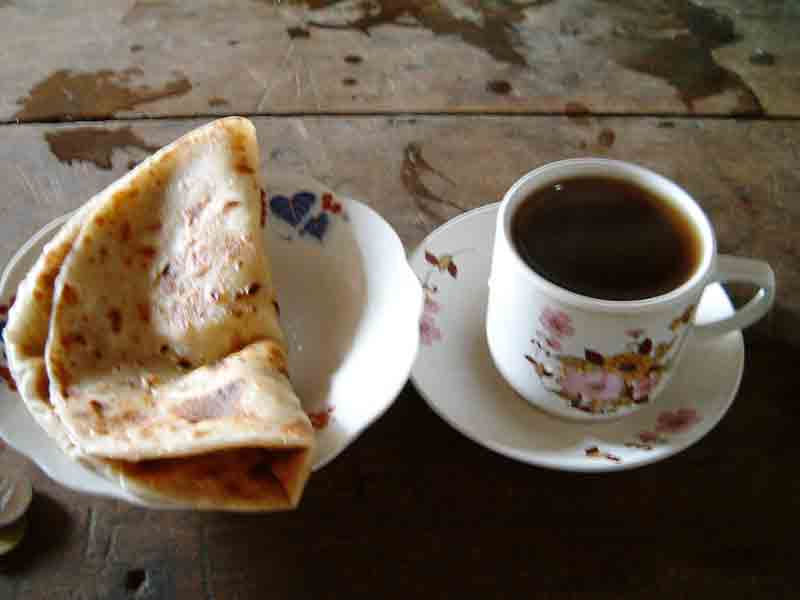
Usually, when I have been offered a Tanzanian breakfast, it consists of a couple of chapati (basically a deep-fried, thick tortilla) and chai (tea). At their worst, chapati can be flavorless, tough gut-busters, but I admit there have been a few times when a nice hot chapati really hits the spot. Granted, that spot is frequently the thighs and rear, so I try to go light on the chapati. The accompanying chai might be plain or spiced with masala, a blend of cinnamon, cloves, and cardamom… yum! Many Tanzanians also eat dense, heavy doughnut-like creations such as maandazi (large and made from wheat) or vitumbua (smaller, made from rice flour). I admit I haven’t tried them yet…

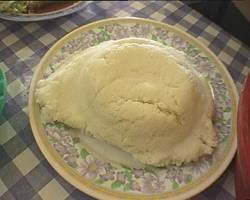
Lunch is normally the biggest meal of the day. Lunch and dinner are similar, and people’s favorite dishes usually depend on the region where they are from. People from coastal towns are more likely to choose rice, while people from inland areas are more likely to favor ugali, which guidebooks and dictionaries like to translate as polenta, but I take issue with that association. Ugali is a kind of doughy, bland, glutinous, springy concoction resembling gluey mashed potatoes crossed with Play-Doh made of maize, cassava, millet, wheat, or sorghum flour. No seasonings are usually added. I think you can tell where I stand on ugali (pictured below).

Along with ugali or rice is served a sauce (sausi), usually tomato-based, often with some sort of meat cooked in it. The sauces are usually delicious. As I am partial to beef, I had a nasty surprise this lunchtime with a mystery meat that turned out to be chicken liver. Side dishes are usually chopped and stewed greens (mchicha), and red beans stewed with onions and spices (maharage). I really love the red beans over rice, maybe because it’s not that far removed from New Orleans-style food. The saving grace for this spicy food lover is pilipili, a kind of semi-cooked hot-pepper salsa. Pilipili are red and green peppers that closely resemble jalapenos or Scotch bonnets in flavor, and are chopped up and cooked with tomatoes and onions. People here think it’s hysterical that an mzungu asks for pilipili. My mother-in-law would love it!
Street food is cheap, very filling, and Tums-worthy. On offer are usually mishkaki (beef kebabs), kuku (chicken), mayai (eggs), or occasionally kitimoto (pork). All are usually accompanied by chipsi (french fries), and occasionally a fresh (or not-so-fresh, depending on how long it has been sitting) tomato and onion salad. The food is commonly precooked and then re-heated in a pan over a grill with a hefty ladling of oil. On the coast, you can occasionally find fried pweza (octopus) on the menu -- be forewarned that it has been tenderized by beating it with a rock on the sandy beach! Below is a picture of a typical food stall (like the one I ate at in Lindi).

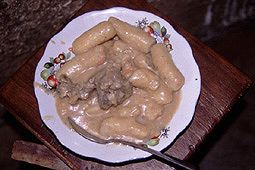
In northwest Tanzania, plantains and green bananas (ndizi) are a staple of people’s diets, and people will often eat plantains with meat in a sauce (ndizi nyama), as in the picture below. Sometimes I enjoy the plantains, especially if the sausi is flavorful, but sometimes they’re a bit chewy and strange. Along the coast, the Swahili influence has infused Indian spices into some of the dishes, so biriyani and pilau are common rice dishes served in coastal towns, with or without meat. I love both of them, though I have to be careful to avoid chomping down on a big piece of cinnamon bark or a whole cardamom pod in my lunch! My favorite meal by far, however, is njegere (peas), which is green shelled peas and other vegetables cooked in a coconut curry and served over rice.

I admit I have been spoiled food-wise by starting out in Dar, where there are tons of Indian restaurants, Chinese restaurants, Ethiopian food, burger joints, French pastry shops, etc. According to the Rough Guide published this past summer, in Mtwara where I will be living once my research project starts, there are only 4 restaurants that serve non-Tanzanian fare, and 3 of these serve only Indian food. And I thought cheese was a precious commodity in Dar…
Usually, when I have been offered a Tanzanian breakfast, it consists of a couple of chapati (basically a deep-fried, thick tortilla) and chai (tea). At their worst, chapati can be flavorless, tough gut-busters, but I admit there have been a few times when a nice hot chapati really hits the spot. Granted, that spot is frequently the thighs and rear, so I try to go light on the chapati. The accompanying chai might be plain or spiced with masala, a blend of cinnamon, cloves, and cardamom… yum! Many Tanzanians also eat dense, heavy doughnut-like creations such as maandazi (large and made from wheat) or vitumbua (smaller, made from rice flour). I admit I haven’t tried them yet…
Lunch is normally the biggest meal of the day. Lunch and dinner are similar, and people’s favorite dishes usually depend on the region where they are from. People from coastal towns are more likely to choose rice, while people from inland areas are more likely to favor ugali, which guidebooks and dictionaries like to translate as polenta, but I take issue with that association. Ugali is a kind of doughy, bland, glutinous, springy concoction resembling gluey mashed potatoes crossed with Play-Doh made of maize, cassava, millet, wheat, or sorghum flour. No seasonings are usually added. I think you can tell where I stand on ugali (pictured below).
Along with ugali or rice is served a sauce (sausi), usually tomato-based, often with some sort of meat cooked in it. The sauces are usually delicious. As I am partial to beef, I had a nasty surprise this lunchtime with a mystery meat that turned out to be chicken liver. Side dishes are usually chopped and stewed greens (mchicha), and red beans stewed with onions and spices (maharage). I really love the red beans over rice, maybe because it’s not that far removed from New Orleans-style food. The saving grace for this spicy food lover is pilipili, a kind of semi-cooked hot-pepper salsa. Pilipili are red and green peppers that closely resemble jalapenos or Scotch bonnets in flavor, and are chopped up and cooked with tomatoes and onions. People here think it’s hysterical that an mzungu asks for pilipili. My mother-in-law would love it!
Street food is cheap, very filling, and Tums-worthy. On offer are usually mishkaki (beef kebabs), kuku (chicken), mayai (eggs), or occasionally kitimoto (pork). All are usually accompanied by chipsi (french fries), and occasionally a fresh (or not-so-fresh, depending on how long it has been sitting) tomato and onion salad. The food is commonly precooked and then re-heated in a pan over a grill with a hefty ladling of oil. On the coast, you can occasionally find fried pweza (octopus) on the menu -- be forewarned that it has been tenderized by beating it with a rock on the sandy beach! Below is a picture of a typical food stall (like the one I ate at in Lindi).

In northwest Tanzania, plantains and green bananas (ndizi) are a staple of people’s diets, and people will often eat plantains with meat in a sauce (ndizi nyama), as in the picture below. Sometimes I enjoy the plantains, especially if the sausi is flavorful, but sometimes they’re a bit chewy and strange. Along the coast, the Swahili influence has infused Indian spices into some of the dishes, so biriyani and pilau are common rice dishes served in coastal towns, with or without meat. I love both of them, though I have to be careful to avoid chomping down on a big piece of cinnamon bark or a whole cardamom pod in my lunch! My favorite meal by far, however, is njegere (peas), which is green shelled peas and other vegetables cooked in a coconut curry and served over rice.
I admit I have been spoiled food-wise by starting out in Dar, where there are tons of Indian restaurants, Chinese restaurants, Ethiopian food, burger joints, French pastry shops, etc. According to the Rough Guide published this past summer, in Mtwara where I will be living once my research project starts, there are only 4 restaurants that serve non-Tanzanian fare, and 3 of these serve only Indian food. And I thought cheese was a precious commodity in Dar…
Monday, December 04, 2006
Bongo Stars...
I feel strangely compelled to make poorly informed comparisons of and generalizations about popular culture. I can’t help it, I’m admit I derived a strange pleasure from watching Bongo Star Search, the Tanzanian equivalent of American Idol, minus a goodly portion of the slick Hollywood production. It even has a Randy Jackson look-alike, complete with the wire-rim glasses. Anyone who knows me knows I don’t watch much TV, but I admit I enjoy the first week or so of each season of American Idol, simply because the performances are so bad that they’re incredibly entertaining. Everyone remembers William Hong’s “She Bangs,” right? I’m happy to report that the story is no different in the tryouts stage of Bongo Star Search, which is a recognizable copycat of American Idol, complete with behind-the-scenes female equivalent of Ryan Seacrest, but with a number of other features that render it uniquely Tanzanian.

First, dancing skill – of both the Britney Spears/Janet Jackson variety and traditional Maasai herdsman style – seems to be much more highly valued on Bongo Star Search than on American Idol. Tanzanians are incredibly good dancers and have an amazing ability to dance and sing simultaneously, which makes the dancing a real talent show, regardless of the style. Second, while many of the contestants are in Western dress (jeans, T-shirts, etc), the round I was just watching featured a guy in traditional Maasai dress (like Yona our guard is wearing in my blog). Maybe he will be the next Bongo Star.
The language difference might make it even more entertaining. First, fully half the tryout songs are in Swahili, and reflect a healthy range of hip-hoppish bongo flava style, romantic ballads, and traditional tribal songs. Most Tanzanians, especially in Dar, speak some English because it is taught in schools, but sung English seems to render some words indiscernible to a ear attuned to Swahili, which means that sometimes it takes me a few bars to realize the song actually has English lyrics! To my utter delight, Shania Twain, Celine Dion, and Whitney Houston are particular favorites.
I rarely had the opportunity to watch television while I was in Mtwara, as we don’t have a TV at home in Dar, and while I had one in my hostel room for the last week, most places in Mtwara have only one satellite or cable feed for the whole complex, meaning that I watched in my room what everyone else watched in theirs, or at least what the guy at the reception desk wanted to watch. Which, in an evangelical Lutheran hostel, means that 80% of the last week I have been exclusively watching Swahili gospel TV on the Agape Television Network. It also means that several times I have been happily enjoying a program, only to have the channel change midstream. Argh.

First, dancing skill – of both the Britney Spears/Janet Jackson variety and traditional Maasai herdsman style – seems to be much more highly valued on Bongo Star Search than on American Idol. Tanzanians are incredibly good dancers and have an amazing ability to dance and sing simultaneously, which makes the dancing a real talent show, regardless of the style. Second, while many of the contestants are in Western dress (jeans, T-shirts, etc), the round I was just watching featured a guy in traditional Maasai dress (like Yona our guard is wearing in my blog). Maybe he will be the next Bongo Star.
The language difference might make it even more entertaining. First, fully half the tryout songs are in Swahili, and reflect a healthy range of hip-hoppish bongo flava style, romantic ballads, and traditional tribal songs. Most Tanzanians, especially in Dar, speak some English because it is taught in schools, but sung English seems to render some words indiscernible to a ear attuned to Swahili, which means that sometimes it takes me a few bars to realize the song actually has English lyrics! To my utter delight, Shania Twain, Celine Dion, and Whitney Houston are particular favorites.
I rarely had the opportunity to watch television while I was in Mtwara, as we don’t have a TV at home in Dar, and while I had one in my hostel room for the last week, most places in Mtwara have only one satellite or cable feed for the whole complex, meaning that I watched in my room what everyone else watched in theirs, or at least what the guy at the reception desk wanted to watch. Which, in an evangelical Lutheran hostel, means that 80% of the last week I have been exclusively watching Swahili gospel TV on the Agape Television Network. It also means that several times I have been happily enjoying a program, only to have the channel change midstream. Argh.
The waiting game...
I don’t have my research permits yet (and have no idea when that will finally happen as I am working through bureaucracies in 2 countries), so I can’t start my project, but while I am waiting, I decided it might be wise to make a preliminary site visit down to Lindi and Mtwara Regions, where I’ll be doing the interviews for my research project. It was convenient that a colleague on the social science team was passing through Dar on his way to Mtwara and could serve as my chaperone… the flight to Mtwara is just under an hour, which, while considerably more expensive than bus or ferry, is well worth it for the sheer difference in comfort and reduction in risk of bodily harm. After several harrowing incidents that almost kept us from making it onto the flight, including a late driver, horrendous traffic, my travel companion being a standby passenger, and pouring rain on the tarmac, we made it onto the plane.
To picture the airport where we landed at Mtwara, imagine the smallest airport in the smallest town you can think of (the closest approximation I can think of is the airport you fly into when traveling to Hanover, NH, but even that was years ago). The baggage claim is a wooden ledge, and immigration and customs is a 3-foot wide booth with a hand-painted sign and an older man who stands behind a folding table checking passports. Even for a domestic flight. This nice gentleman only checks wazungu passports (how’s that for racial profiling?), recording their details in a carefully lined notebook. I managed to escape the check, probably 1) because I was traveling with a Tanzanian and lacked the tourist gloss, and 2) because of the stricken expression on my face, having just realized my bag hadn’t arrived in the “baggage claim” (i.e., it wasn’t on the cart), and was still on the plane, Mozambique-bound with most of my earthly Tanzanian possessions. Thankfully the plane was headed back to Mtwara later that afternoon, so after filing a lost bag report (written in marker on a napkin), waiting in town a few hours and snacking on some delicious pilau, we picked up the bag and headed out to the field.
We slept in a town north of Mtwara called Lindi for the first three days because the nearby village the team was working in, Chikonji, was too small even to have a guesthouse. This posed a bit of a challenge to my colleague, who was to stay on in Chikonji for a week — sans Land Cruiser — to do ethnographic interviews. I liked to joke with him that he should look into sleeping in the goat house, which are small raised houses on stilts – kind of like hen houses – raised off the ground to keep the goats out of reach of prowling hyenas at night. Toting along his own mattress and bottled water, my colleague managed one better than sleeping with the goats: he finagled a room for himself in a local house with a very sweet family, and the local kids were excited about the new visitor (and the chance to see themselves on a digital camera screen).

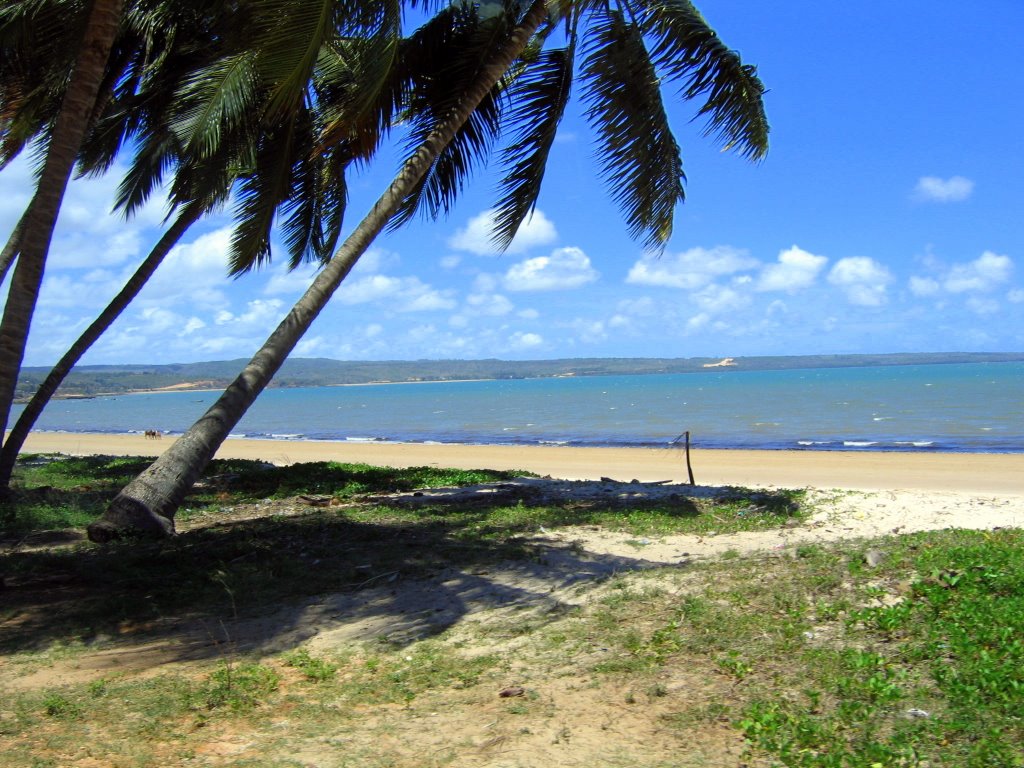
Lindi, where we spent a few nights, is a medium-sized town built right on the Indian Ocean. As you can see below, the view from our guesthouse was incredible (though I have declined to feature the guesthouse because, well, suffice it to say it won’t ever be featured in any guidebooks).

In the afternoons after we returned from the village, we would go work on the beach where there was a local café serving cold beer and soda. Pickings were slim for meals: the first evening we went to the kituo cha basi (bus station), or the “standi.” The sheer amount of oil one consumes in a single meal at the standi -- mine was mishikaki (basically shish kebabs), chipsi (fries), and mayai (a very oily tomato and onion omelet) -- is mind-boggling. Suffice it to say the next few evenings I had bananas and tea for dinner.

Little did I know that Thanksgiving would be the last day of good eats -- roasted corn on the side of the road, peanuts, deep-fried chicken (no batter), and more chipsi -- before the dry spell that befell me once I arrived in Mtwara for the weekend. There were no restaurants open near my hostel over the weekend, leaving me to survive on beef jerky, mangoes, Skittles, Pepsi, and a whole lot of cashews... mmm!
To picture the airport where we landed at Mtwara, imagine the smallest airport in the smallest town you can think of (the closest approximation I can think of is the airport you fly into when traveling to Hanover, NH, but even that was years ago). The baggage claim is a wooden ledge, and immigration and customs is a 3-foot wide booth with a hand-painted sign and an older man who stands behind a folding table checking passports. Even for a domestic flight. This nice gentleman only checks wazungu passports (how’s that for racial profiling?), recording their details in a carefully lined notebook. I managed to escape the check, probably 1) because I was traveling with a Tanzanian and lacked the tourist gloss, and 2) because of the stricken expression on my face, having just realized my bag hadn’t arrived in the “baggage claim” (i.e., it wasn’t on the cart), and was still on the plane, Mozambique-bound with most of my earthly Tanzanian possessions. Thankfully the plane was headed back to Mtwara later that afternoon, so after filing a lost bag report (written in marker on a napkin), waiting in town a few hours and snacking on some delicious pilau, we picked up the bag and headed out to the field.
We slept in a town north of Mtwara called Lindi for the first three days because the nearby village the team was working in, Chikonji, was too small even to have a guesthouse. This posed a bit of a challenge to my colleague, who was to stay on in Chikonji for a week — sans Land Cruiser — to do ethnographic interviews. I liked to joke with him that he should look into sleeping in the goat house, which are small raised houses on stilts – kind of like hen houses – raised off the ground to keep the goats out of reach of prowling hyenas at night. Toting along his own mattress and bottled water, my colleague managed one better than sleeping with the goats: he finagled a room for himself in a local house with a very sweet family, and the local kids were excited about the new visitor (and the chance to see themselves on a digital camera screen).

Lindi, where we spent a few nights, is a medium-sized town built right on the Indian Ocean. As you can see below, the view from our guesthouse was incredible (though I have declined to feature the guesthouse because, well, suffice it to say it won’t ever be featured in any guidebooks).
In the afternoons after we returned from the village, we would go work on the beach where there was a local café serving cold beer and soda. Pickings were slim for meals: the first evening we went to the kituo cha basi (bus station), or the “standi.” The sheer amount of oil one consumes in a single meal at the standi -- mine was mishikaki (basically shish kebabs), chipsi (fries), and mayai (a very oily tomato and onion omelet) -- is mind-boggling. Suffice it to say the next few evenings I had bananas and tea for dinner.
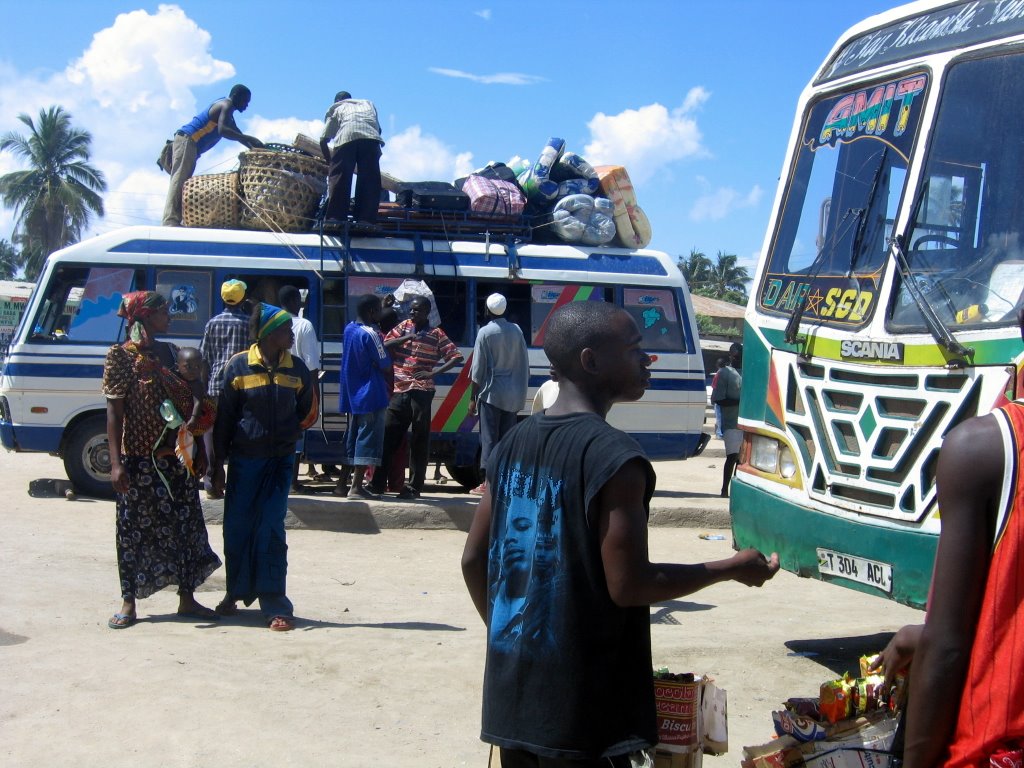
Little did I know that Thanksgiving would be the last day of good eats -- roasted corn on the side of the road, peanuts, deep-fried chicken (no batter), and more chipsi -- before the dry spell that befell me once I arrived in Mtwara for the weekend. There were no restaurants open near my hostel over the weekend, leaving me to survive on beef jerky, mangoes, Skittles, Pepsi, and a whole lot of cashews... mmm!
Monday, November 27, 2006
Cashews
I love cashews. I have been eating them as the staple of my diet for the past 3 days (not entirely deliberately, see my next post). I’m currently visiting the area where I will be living and working for most of my stay in Tanzania: the rural villages of Lindi and Mtwara Rural regions. The area is famous for its cashew (korosho) production, and infamous for its underdevelopment. I had a tour of the zonal capital, Mtwara, yesterday, and was astounded how much smaller and quieter it is than chaotic Dar es Salaam. I’m sure there I will have more to say about underdevelopment in the future, so indulge me while I talk about cashews, as November marks the beginning of the cashew harvest and it’s cashews, cashews, everywhere…
I spent Tuesday through Thursday last week in a tiny village called Chikonji, northwest of Lindi. People here say it’s in the jungle (mwitu) but it doesn’t jive with most Americans’ stereotypical jungle imagery. Neither is it really like the African bush you see in movies or National Geographic. Near the ocean, mangrove swamps and palms predominate, but upland as in places like Chikonji, all you see are fruit trees—coconut palms, mangoes, and cashews.

My prior knowledge of cashews was limited to the fact that they are the really good nuts I try to eat first in those cans of fancy mixed nuts. Really they are the seed that dangles from a completely bizarre fruit. Below is a picture of cashew fruits; the familiar part of the cashew we snack on after a good roast and a liberal application of salt is inside the seed pod hanging off the fruit.

When ripe, the fruit and the seed pod fall to the ground together and are harvested. The fruit is set aside and used to brew local beer (haven’t had it yet but I’m sure it’s memorable, as most local brews are!). The pods are washed and popped open with a knife to expose the cashew nut, and then the cashews are roasted over a fire. In the village, this means they get a few nice brown spots here and there, but also a richer flavor. Even after roasting, they have a papery coating like peanuts do. Below is a picture of moshi wa korosho (cashew smoke during roasting):

For better or worse, the crop price for cashews is controlled by the Tanzanian government. It’s big business: here in Mtwara, one of the biggest government offices in town is the Bodi ya Korosho (Cashew Board). Yesterday, I saw a huge cargo ship in Mtwara Harbor, presumably laden with cashews, and likely bound for India, where most of the Tanzanian cashew crop is roasted, salted, and packaged—by hand, mind you, as it’s a way to employ many people—for happy hours worldwide. Recently there has been some debate in the papers about the government-set cashew price for this year, because apparently there is pressure from buyers for lower prices. Obviously, lower prices would hurt the cashew farmers, who rely on the cashew crop revenue to invest in fertilizers and supplies for next year, not to mention food to live on until then. With all the transoceanic travel these cashews do, it’s no wonder they’re stratospherically expensive. Still, I suspect the middlemen and the shipping companies clean up compared to the poor farmers who live here and do the lion’s share of the work.
Sadly, cashews are often blamed for recent seasonal spikes in crime in this sleepy town (Mtwara). Where there are international buyers, there are noticeable influxes of foreign money, which lures opportunistic thieves from other regions in Tanzania and Mozambique. Petty theft and break-ins surge during the cashew harvest season. It’s really a shame, as from what I’ve seen, Mtwara is known for being peaceful and bucolic.
I spent Tuesday through Thursday last week in a tiny village called Chikonji, northwest of Lindi. People here say it’s in the jungle (mwitu) but it doesn’t jive with most Americans’ stereotypical jungle imagery. Neither is it really like the African bush you see in movies or National Geographic. Near the ocean, mangrove swamps and palms predominate, but upland as in places like Chikonji, all you see are fruit trees—coconut palms, mangoes, and cashews.
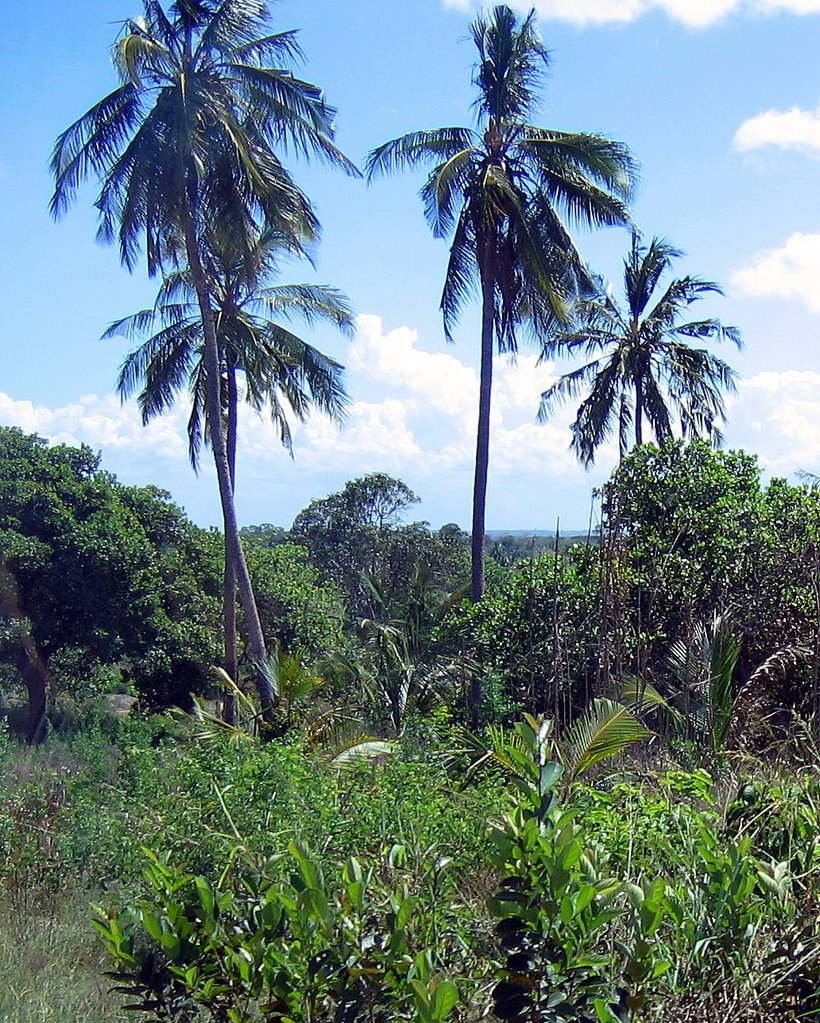
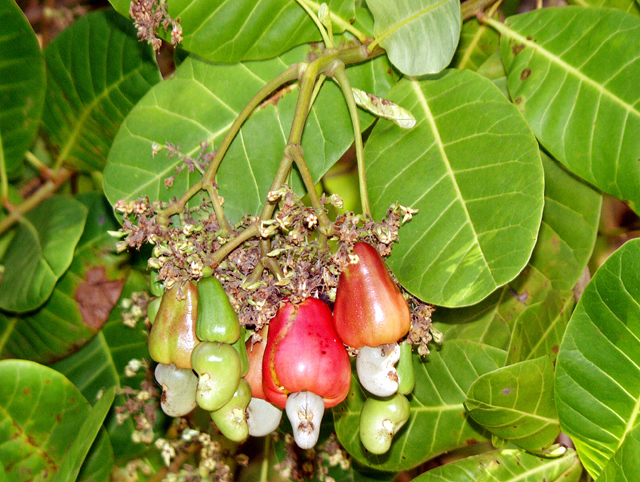
My prior knowledge of cashews was limited to the fact that they are the really good nuts I try to eat first in those cans of fancy mixed nuts. Really they are the seed that dangles from a completely bizarre fruit. Below is a picture of cashew fruits; the familiar part of the cashew we snack on after a good roast and a liberal application of salt is inside the seed pod hanging off the fruit.
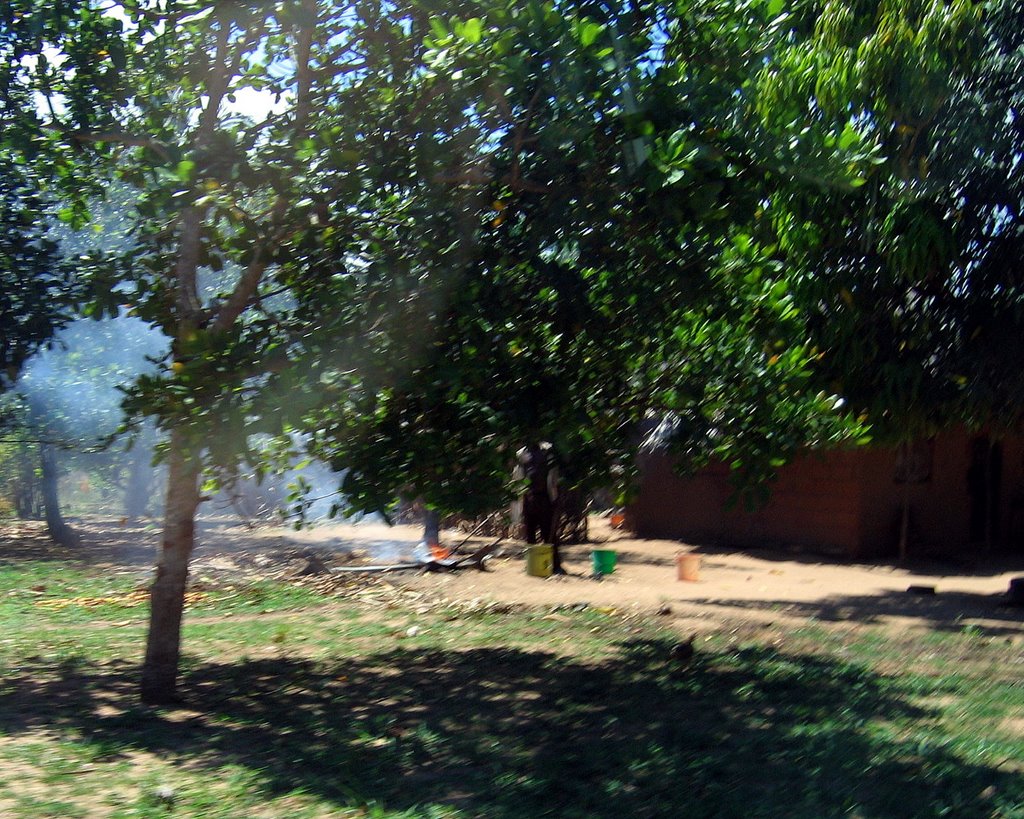
When ripe, the fruit and the seed pod fall to the ground together and are harvested. The fruit is set aside and used to brew local beer (haven’t had it yet but I’m sure it’s memorable, as most local brews are!). The pods are washed and popped open with a knife to expose the cashew nut, and then the cashews are roasted over a fire. In the village, this means they get a few nice brown spots here and there, but also a richer flavor. Even after roasting, they have a papery coating like peanuts do. Below is a picture of moshi wa korosho (cashew smoke during roasting):
For better or worse, the crop price for cashews is controlled by the Tanzanian government. It’s big business: here in Mtwara, one of the biggest government offices in town is the Bodi ya Korosho (Cashew Board). Yesterday, I saw a huge cargo ship in Mtwara Harbor, presumably laden with cashews, and likely bound for India, where most of the Tanzanian cashew crop is roasted, salted, and packaged—by hand, mind you, as it’s a way to employ many people—for happy hours worldwide. Recently there has been some debate in the papers about the government-set cashew price for this year, because apparently there is pressure from buyers for lower prices. Obviously, lower prices would hurt the cashew farmers, who rely on the cashew crop revenue to invest in fertilizers and supplies for next year, not to mention food to live on until then. With all the transoceanic travel these cashews do, it’s no wonder they’re stratospherically expensive. Still, I suspect the middlemen and the shipping companies clean up compared to the poor farmers who live here and do the lion’s share of the work.
Sadly, cashews are often blamed for recent seasonal spikes in crime in this sleepy town (Mtwara). Where there are international buyers, there are noticeable influxes of foreign money, which lures opportunistic thieves from other regions in Tanzania and Mozambique. Petty theft and break-ins surge during the cashew harvest season. It’s really a shame, as from what I’ve seen, Mtwara is known for being peaceful and bucolic.
Sunday, November 12, 2006
Habari za mbuzi?

Shame on me -- I have been promising news of goats (habari za mbuzi) but not delivering. Being a doctoral student, particularly one doing qualitative research, means my life for the foreseeable future will be comprised primarily of writing, so sometimes it’s hard to self-motivate to write for fun.
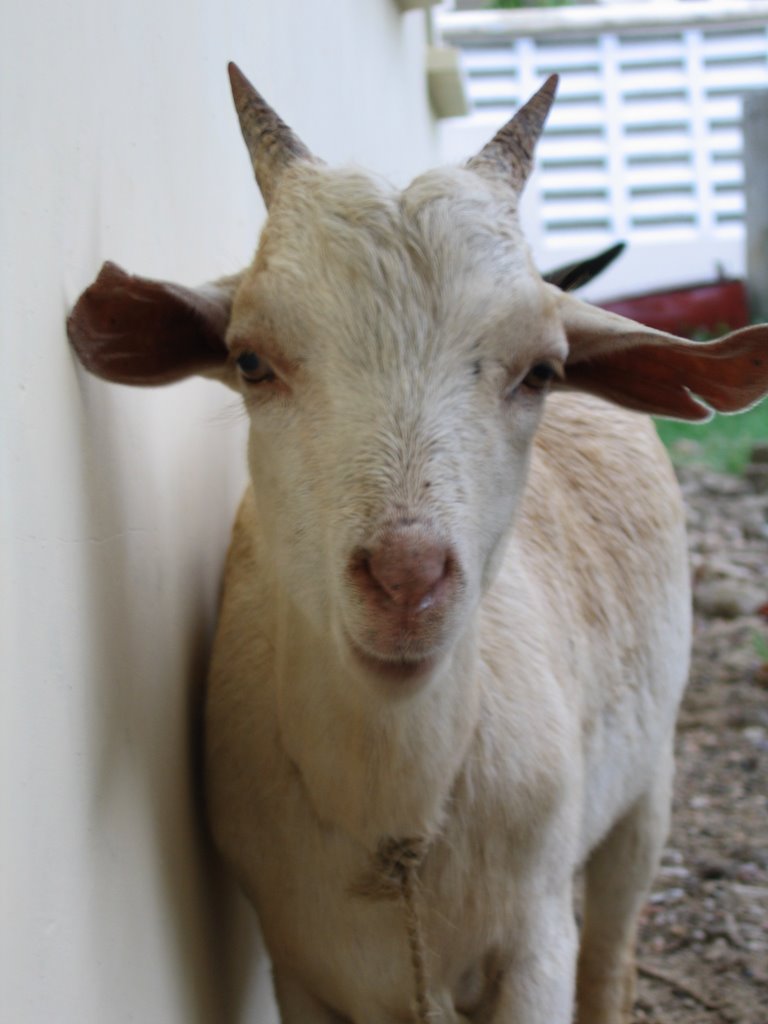
Anyway, back to the goats. About a week ago, Bre and Josh, the very generous couple I’m staying with here, were musing about how kitchen and household trash accrues in the yard (at least until it gets burned in a hole out back), and how grass gets cut around here (usually with some permutation of a machete), and how funny it would be to be known as goat-owning wazungu (foreigners). At the time, I was reading a book--for my two-member long-distance husband-wife book club) that talked about how the Saudi Arabian kingdom used hungry goats as citywide garbage control as late as the 1970s, and this might have been a catalyst for more serious thinking about the perks of small-scale goat husbandry here in Msewe. Bre and Josh already live in a walled compound that suffers from no lack of weeds and patches of uncut grass, and have a built-in herdsman: their night watchman, Yona, is a Maasai man from the vast steppe straddling Kenya and Tanzania, near Mount Kilimanjaro. He mumble-sings traditional pastoral tunes to himself perpetually, and he walks around with a long staff as a permanent fashion accessory. The initial idea was to get one goat, but after talking with Yona, the idea of two goats – a nanny and a billy – with the prospect of lots of little baby goats down the line – began to grow on Josh. And who better to buy said goats, than the Maasai Goat Whisperer himself?

We all mulled over names for a couple of days, and while Matunda and Mboga (Fruits and Vegetables) were front-runners for awhile, Dick and Condi emerged as dark-horse (dark-goat?) winners at the last minute, perhaps inspired by all the excitement leading up to the US election. A few nights and a few tens of thousands of shillings later, Josh and Bre came home late from dinner to find the goats already settled in the house in Msewe. Their names stuck instantly as soon as we saw them: Dick is pale and broad-faced, masking unparalleled cunning by goat standards, with the uncanny ability to sneer-smile with his little goat-lips. Condi is tiny and dark-speckled, and is utterly submissive to Dick (don’t know if that is symbolically important). Bre has a suspicion that both are neoconservatives hellbent on world domination, a plan plotted from their own backyard. I think she may be right, but their prospects may be a bit dimmer after last Tuesday (just re-grouping, perhaps?).
News of the goats' arrival traveled fast, despite no lack of barnyard animals in Msewe. Dick is quite well endowed, as Yona was quick to point out (by grabbing and displaying said endowment). He has quickly become the most sought-after billy goat around, and now boasts a harem of a minimum of three nannies, with plans to be studded out to even more. Apparently, there are visions of little goat kiddies dancing in most of the neighbors’ heads… and we are already contemplating the prospects of a quaint artisanal cheesery in Msewe. We like to call this little experiment our own little micro-Heifer Project. Donations, anyone?
Thursday, November 02, 2006
Pimp my ride...
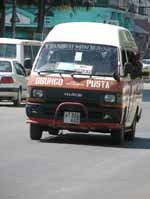 I took a couple of taxis the first couple of days after I arrived in Dar es Salaam, while my wallet could still handle it. I was shocked that a ride of just 2-3 miles could easily cost 7000 shillings ($6 USD!). Granted, gas costs $5 per gallon here, so it’s unlikely there’s any price gauging of wazungu going on. Even fewer people can afford cars than can afford a taxi ride, and yet people rarely seem to walk long distances in the heat. So how, I wondered, do most Tanzanians get around? Enter the daladala, the Tanzanian version of the chicken bus.
Daladalas are so named because a ride once cost the equivalent of a US dollar – now, thanks to devaluation of the shilling, it’s roughly 16 cents. The term daladala is loosely applied to a wide variety of vehicles, most of them essentially 15-passenger Toyota conversion vans from East Asia (some still flaunt Chinese or Japanese characters on the sides and back). There is also a larger version that looks more like a Third-World city bus, and deceptively, even says “City Bus” on both sides – it is, however, merely a daladala. All have a large sliding door on the left side where passengers get on and off, and from which the conductor (kondakta in Swahili) hangs while the daladala is in motion, usually erratically. There are no laws about the maximum number of people permitted to ride on a daladala, and they rarely leave stops until they are completely full, usually holding as many as 23 or 24 people, and a friend of mine swears she once counted 31 people on a daladala. However (thankfully?), there is a law that the door must be closed while the daladala is moving… go figure. I got some nasty sneers today for asking to get off at a non-established stop on a busy road (at least I think that is what invited the sneers) – but how would this ignorant mzungu know? Extricating oneself, particularly if you’ve been lucky enough to get a seat, is an adventure in and of itself, and it’s standard procedure to crawl and push your way over multiple people and seats to make it to the door. Suffice it to say, personal space is an unheard-of luxury. I have even found myself providing free babysitting services when space is at a premium – I had a Tanzanian toddler plopped atop of my lap (on top of my backpack) yesterday when space got tight. An American kid might have wailed, but he just sat there until the daladala emptied out a little, then crawled over the seat in front of us to rejoin his dad.
My biggest challenge is figuring out which daladala to take to get to (or close to) one’s desired destination. There are no daladala route maps, but each route’s beginning and end are painted in stenciled white letters on the front. After awhile, you start to notice those that routinely ply the same route because many of them are decked out with ornate decorative elements. Religious imagery and phrases are common decorations, presumably for their amuletic ability to compensate for the often reckless driving. For some reason, Islamic phrases (Allah Karim, Allah Akbar) bedecking daladalas are much more staid than the Christian ones (e.g., Jesus’ Family, Top Jesus), which always make me grin. But my favorite is Afrika Babu Kubwa (“Big Grandpa Africa”). Traffic or heavy rain can cause a daladala driver to take a long-cut through neighborhoods of unpaved, bumpy roads, which add to the exoticism, or annoyance, depending on one’s perspective. And pity the person who has to take a jump seat in the space that would ordinarily be the aisle, or worse yet, who has to stand, bent at the waist with one’s head against the roof of the daladala. It’s the perfect setting for a Dial soap ad…
Mud

The mosquitoes are coming. I can feel it, though I have yet to make a positive ID. It’s hard to live in coastal Tanzania and work in public health--and in conjunction with a malaria project, no less--without being abnormally paranoid about getting malaria. I arrived fully armed with insecticide-impregnated bednet, antimalaria pills, and enough DEET to protect the entire US military, but ironically, I’ve noticed only one bite since I arrived, and that very well could have been a spider. I seem not to be the most appealing target for mosquitoes. However, they have a predilection for my friend Anne, who confirmed her second case of malaria this morning… but then again, that could be related to her fondness for infested pit latrines…
The kaskazi (monsoon) rains that normally arrive in mid to late November and last into January seem to be arriving a bit earlier than usual. Along with the 100% humidity, their early arrival means that mold and mildew are having a field day among my belongings. Most mornings lately I awake to the sound of pounding rain – big, tropical rain plopping on the ground outside. Within hours, it can transform the modest dirt path into town into a slushy, grimy, clay Slip n’ Slide with several vehicular casualties in ditches on the side of the road. For reasons defying logic, dirt roads here are deliberately graded with steep slopes off the side, so vehicles can easily slide off the flat surface. My friends’ Daihatsu Feroza 4x4 (no, I am not making that up) has lately been fishtailing its way to and from the University. The Chinese are building a large road between the University and the main road downtown, working on the underlayment now, so the road they are building is about 4 feet lower than and runs alongside the existing road.They might as well be engineering an aqueduct – what was a dry roadworks project-in-progress when I arrived is undifferentiable from a river.
Yesterday, the rain had seemed to let up and the weather was breezy, cool, and cloudy by the time I got off the daladala at the cell phone store this morning, so I decided to walk the rest of the way to work (about 2 miles). Bad idea. No more than 5 minutes after I started walking, the rain returned with a vengeance: the heavens opened and I was fully soaked in a matter of 60 seconds. If there had been a wet T-shirt contest for wazungu, I would have won. The Tanzanians I passed were all huddled under eaves and umbrellas, incredulously watching this brazen mzungu stomp through the mud in her flip-flops, soaked to the core. I must have heard Pole sana, dada (roughly: “take it easy, poor sister”) a hundred times in a mile and a half. All I know how to say in Swahili is “Big rain, no problem.” They must think I’m crazy. Six hours later, I am just beginning to dry out.
Tuesday, October 31, 2006
One who walks in circles
Being a sunburn-prone redhead, I was forced to give up a long time ago on trying to blend in in Africa. In Ethiopia I was a farenj (foreigner), here, I am an mzungu, or more literally, “one who walks in circles.” I often feel the term is very apt, given how lost I feel much of the time. Aside from occasionally being addressed as dada (sister) or mama (married lady) or the less plausible beautifulgirlhello! (hollered in nearly unrecognizable singsong through a bus window), the most common moniker I get is mzungu, whether hollered at me on the street or said in hushed Swahili as I enter a room. It almost reminds me of a game of punchbuggy, where they’re rare enough that just spotting one constitutes a game in and of itself.
Subscribe to:
Posts (Atom)